
You sit down at your desk with a long to-do list, but by noon you've only crossed off two small items. The day feels busy yet unproductive. The problem isn't your work ethic—it's your planning method.
Most people either overplan with rigid schedules that break at the first interruption, or underplan and drift aimlessly. The sweet spot is a flexible, repeatable routine that takes just 10 minutes per day. This guide walks you through a complete daily planning system, from the night before to the end-of-day review.
You'll learn how to set priorities, schedule your energy, and adapt when things go wrong. No complicated apps or productivity gimmicks—just practical steps you can start tonight.
Why Most Day Plans Fail (And How to Fix It
You sit down every morning with good intentions. You list out tasks, assign times, and feel a surge of optimism. Then, by 10 a.m., the plan is in shambles.
An urgent email, a colleague’s request, a task that took twice as long as expected—and suddenly you’re just reacting. This isn’t a personal failure. Most day plans fail because of two common traps: overplanning and underplanning.
Understanding these patterns is the first step to building a routine that actually works.
The Overplanning Trap
Overplanning happens when you schedule every minute of your day with zero buffer. You assume you’ll work at peak focus for hours, that nothing will go wrong, and that every task will take exactly the time you allotted. Reality hits fast.
One interruption can domino into a cascade of missed deadlines, leaving you frustrated and convinced that planning doesn’t work. The fix? Leave white space.
Plan for only 60–70% of your available time, and treat the rest as buffer for the unexpected.
The Underplanning Trap
Underplanning looks like the opposite: you have a vague mental list of things to do, but no structure. You start the day without a clear priority, so you drift from task to task, often getting stuck on low-value busywork. By afternoon, you realize the important project hasn’t been touched.
Underplanning feels flexible, but it actually creates decision fatigue because you’re constantly figuring out what to do next. The fix? Commit to a single most important task (MIT) each day and schedule it first.
Both traps share a common root: a lack of realistic prioritization. The mindset shift you need is simple: a plan is not a prison. It’s a flexible guide that helps you focus on what matters, while leaving room for life to happen.
Once you accept that no plan survives first contact with reality, you can build one that bends instead of breaks.
The Night Before: Set Tomorrow Up for Success

The key to a productive day isn’t a morning miracle—it’s what you do the night before. A few minutes of evening prep can clear your mind, sharpen your focus, and help you wake up ready to act. Here’s a simple three-step routine that takes less than 15 minutes.
- Brain Dump Everything: Write down every task, worry, or idea floating in your head. This clears mental clutter and reduces anxiety, so you can sleep better and start fresh.
- Identify Your Top 3 Priorities: From your brain dump, pick the three most important tasks for tomorrow. This is the Ivy Lee Method in action—focus on what truly moves the needle.
- Prepare Your Environment: Lay out clothes, pack your bag, and set up your workspace. Remove friction so you can start your morning without decision fatigue.
Why This Works
Your brain loves closure. By externalizing your to-do list and making micro-decisions ahead of time, you free up mental energy for deep work. Plus, a prepared environment signals to your brain that it’s time to focus, not scramble.
Tip
Keep a notebook or a simple app by your bed. The goal is to capture everything—don’t filter or judge. You can organize tomorrow morning.
Your Morning Routine: The First 30 Minutes
How you start your morning sets the tone for the entire day. Instead of immediately checking emails or social media, use the first 30 minutes to get grounded and focused. This short routine helps you avoid reactive mode and gives you control over your schedule.
The key is to begin with intention, not urgency. Here’s a simple two-step morning routine that takes just 30 minutes and dramatically improves your productivity.
Review Your Plan (2 Minutes
Before you open your inbox or pick up your phone, take two minutes to review the plan you set the night before. Look at your top priorities and the time blocks you scheduled. This quick review reinforces your intentions and helps you start the day with clarity.
Why do this before email? Because email is often a distraction disguised as work. By reviewing your plan first, you ensure your own priorities come before others’ requests.
Do Your Most Important Task First (Eat That Frog
Mark Twain once said, “Eat a live frog first thing in the morning, and nothing worse will happen to you the rest of the day.” In productivity terms, your “frog” is your most important task (MIT)—the one that will have the biggest impact. Tackle it first, before your willpower runs out.
Benefits of doing your MIT first
- You make progress on what truly matters before distractions arise.
- You avoid decision fatigue later in the day.
- You build momentum and a sense of accomplishment.
Aim to spend 25–30 minutes on your MIT. If it’s a larger project, break it into a single actionable step. For example, if your MIT is to prepare a presentation, your first step might be to outline the slides.
Once you’ve completed that, you’ve already won the morning.
How to Prioritize When Everything Feels Urgent
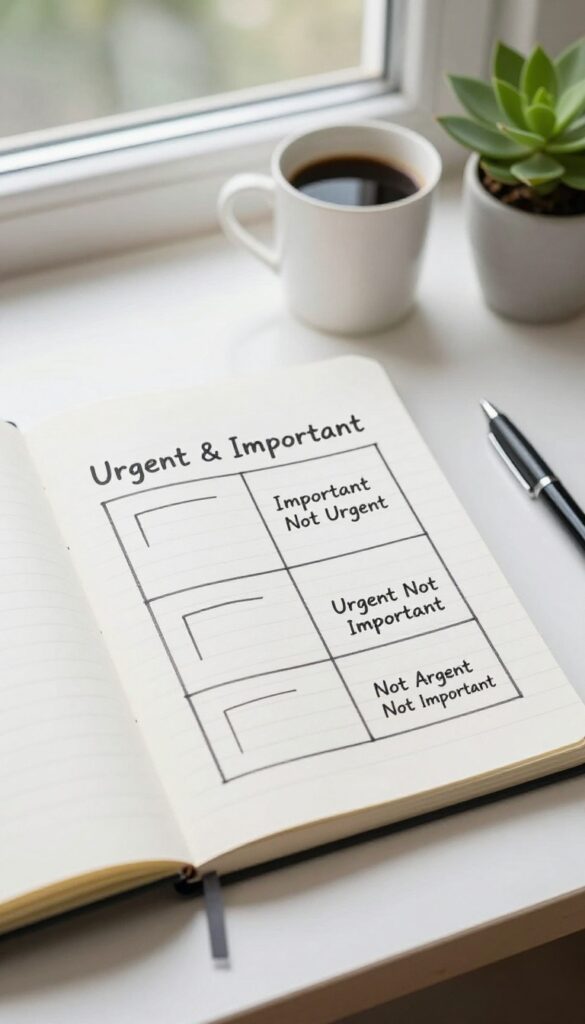
When your to-do list is overflowing and every task seems urgent, prioritization becomes your lifeline. Instead of guessing, use a proven framework to separate what truly matters from what only feels urgent. Here are two simple methods you can start using today.
The Eisenhower Matrix Simplified
The Eisenhower Matrix helps you sort tasks by urgency and importance. Draw a 2×2 grid and label the quadrants:
- Urgent and Important: Do these now. They’re your top priorities.
- Important, Not Urgent: Schedule these. They’re key to long‑term goals.
- Urgent, Not Important: Delegate or handle quickly. They’re distractions.
- Not Urgent, Not Important: Eliminate or postpone. They’re time‑wasters.
This matrix instantly clarifies where to focus. Most people spend too much time on urgent‑but‑not‑important tasks. The magic lies in protecting time for the important‑not‑urgent quadrant—that’s where growth happens.
The 1-3-5 Rule
If the matrix feels too analytical, try the 1-3-5 rule. Each day, pick:
- 1 big task (your main priority for the day)
- 3 medium tasks (important but not critical)
- 5 small tasks (quick wins or admin)
This rule prevents overloading your day. It forces you to be realistic about what you can accomplish. The big task gets your best energy; the small tasks fill the gaps.
Adjust the numbers to fit your workload—the principle is balance, not rigidity.
Which method should you choose? If you’re overwhelmed by many competing priorities, start with the Eisenhower Matrix to gain clarity. If you have a clear sense of your main goal but struggle to keep the rest manageable, the 1-3-5 rule is simpler and faster.
Both work—pick the one that feels most natural and use it daily.
Time Blocking: Schedule Your Day in Chunks

Once you know your priorities, it’s time to assign them to specific parts of your day. Time blocking is a proven technique that turns your to-do list into a structured schedule, making it easier to focus and get things done.
Step 1: Map Your Energy Peaks
Start by identifying when you have the most energy. Are you a morning person who crushes deep work before noon? Or do you hit your stride in the afternoon?
For one week, note your energy levels every hour. You’ll likely see patterns: high-energy windows (ideal for focused work), medium-energy periods (good for routine tasks), and low-energy slumps (perfect for breaks or easy admin). Use this map to schedule your most demanding tasks during your peak times.
Step 2: Assign Tasks to Time Blocks
Now, divide your day into blocks—typically 60–90 minutes each—and assign each block a specific type of work. Common block types include:
- Deep work blocks: for focused, high-value tasks (e.g., writing, coding, strategic planning).
- Shallow work blocks: for emails, meetings, and routine tasks that require less concentration.
- Break blocks: short 5–15 minute pauses to recharge, plus a longer lunch break.
For example, you might schedule a deep work block from 9–10:30 AM, a shallow work block from 11–12 PM, and a break from 12–1 PM. Be realistic about how many blocks you can fit in a day—quality over quantity.
Step 3: Include Buffer Time
No plan survives contact with reality. That’s why buffer time is essential. Add 15–30 minute buffers between blocks to handle overflows, unexpected requests, or just to stretch.
This prevents your schedule from feeling like a rigid trap and gives you breathing room. A good rule of thumb: aim for no more than 70% of your day to be blocked; leave 30% flexible.
Pro Tip
Use a digital calendar or a paper planner to visualize your blocks. Color-code them by type (e.g., blue for deep work, green for breaks) so you can see your day at a glance.
Staying on Track During the Day
You’ve planned your day, prioritized your tasks, and set up time blocks. Now comes the real challenge: executing the plan without getting derailed. Staying on track isn’t about willpower—it’s about having the right strategies to handle distractions, maintain focus, and adapt when things change.
Single-Tasking vs Multitasking
Multitasking feels productive, but it actually reduces the quality of your work and increases the time it takes to finish tasks. When you switch between tasks, your brain needs to refocus each time, costing you up to 40% of your productive time. Single-tasking—focusing on one task at a time—lets you dive deeper, make fewer mistakes, and finish faster.
To practice single-tasking, close unnecessary tabs, put your phone out of sight, and commit to working on one task for a set period (like a 25-minute Pomodoro).
Managing Distractions
Distractions are inevitable, but you can minimize their impact. Start by identifying your biggest distractions—whether it’s email notifications, social media, or chatty coworkers—and create barriers. For digital distractions, use app blockers or turn on “Do Not Disturb” mode during focus blocks.
For physical distractions, set clear boundaries: let your team know you’re in a focus session, wear headphones, or work in a quiet space. When a distraction pops up, jot it down on a “distraction list” and return to it later instead of acting on it immediately.
When to Pivot (Gracefully
No plan survives the day intact. Unexpected meetings, urgent requests, or personal interruptions will happen. The key is to pivot without guilt.
When something unexpected arises, quickly assess: Is it truly urgent and important? If yes, reschedule a lower-priority task from your time block. If not, schedule it for later or delegate it.
Keep a “parking lot” for non-urgent ideas or tasks that come up during the day. And remember, pivoting doesn’t mean abandoning your plan—it means adjusting it so you still accomplish what matters most.
End-of-Day Review: Close the Loop
The end of your day is not just a finish line—it's a launchpad for tomorrow. A quick 5-minute review helps you celebrate progress, learn from hiccups, and set yourself up for a smoother next day. Don't skip it because it feels optional; it's the glue that turns a good day into a great routine.
What Went Well?
Start by acknowledging your wins. Even on a chaotic day, there's always something that went right. Ask yourself: Did I finish a key task?
Help a colleague? Stay focused during a meeting? Write down 2–3 highlights.
This builds momentum and trains your brain to spot progress, not just gaps.
What Could Be Better?
Now, look honestly at what didn't go as planned. Were you distracted by notifications? Did you underestimate how long a task would take?
Did you skip a break and feel drained? Identify one or two specific areas for improvement—no self-criticism, just data. This helps you adjust tomorrow.
Set Tomorrow's Top 3
Before you close your notebook or app, decide on the three most important tasks for tomorrow. These should be the ones that, if done, make the day feel successful. Write them down now so you can hit the ground running in the morning without decision fatigue.
Quick End-of-Day Review Checklist
- Look at your original plan for today.
- Check off completed tasks and celebrate them.
- Move unfinished tasks to tomorrow's list or a future date.
- Note any surprises or interruptions that threw you off.
- Write down one thing you learned today.
- Set your Top 3 priorities for tomorrow.
- Close your work tools and transition to personal time.
Common Planning Pitfalls and How to Avoid Them
Even the best daily plan can fall apart if you stumble into common traps. Here are three frequent pitfalls and simple fixes to keep your routine on track.
Pitfall 1: Overcommitting
It's tempting to pack your schedule with tasks, but overestimating what you can accomplish leads to frustration and burnout. The fix: be realistic about time. Use the "two-minute rule" for quick tasks, and for larger ones, estimate how long they actually take—then add a 20% buffer.
Start each day with a "must-do" list of no more than three priorities.
Pitfall 2: Ignoring Energy Levels
Planning your day without considering your natural energy rhythms sets you up for failure. If you're a morning person, schedule deep-focus work early; if you hit a slump after lunch, save routine tasks for that time. Track your energy for a week to identify patterns, then align your most demanding tasks with your peak hours.
Pitfall 3: No Buffer for Interruptions
Unexpected calls, emails, or emergencies can derail a rigid schedule. The solution: build in buffer time. Reserve 15–30 minutes between major blocks for catch-up and unexpected requests.
Also, designate a "flex hour" each afternoon to handle overflow. This way, interruptions become part of the plan rather than disruptions.
Quick Recap: Avoid These Traps
- Overcommitting → Limit to three priorities per day.
- Ignoring energy → Schedule tasks to match your energy peaks.
- No buffer → Add 15–30 minute buffers between blocks.
FAQ
What if I can't stick to my plan?
That's normal. Plans are guides, not prison sentences. If you deviate, simply adjust.
The key is to review at the end of the day and learn what went wrong. Maybe you overcommitted or didn't account for interruptions. Tweak your plan tomorrow.
How long should I spend planning each day?
About 10 minutes total: 5 minutes the night before and 5 minutes in the morning. The evening session is a brain dump and priority setting. The morning is a quick review.
Resist the urge to plan for hours—that's procrastination.
Should I plan every hour?
No. Hour-by-hour planning is too rigid and stressful. Instead, use time blocks of 1-3 hours for similar tasks.
Leave buffer time between blocks. This gives you structure without micromanaging your time.
What's the best time of day to plan?
The evening before is ideal because it offloads decisions from your morning brain. But if you prefer mornings, do it first thing before checking email or social media. Consistency matters more than the exact time.
How do I handle unexpected urgent tasks?
First, assess if it's truly urgent or just someone else's priority. If it's urgent, swap it into your schedule and move a less important task to another day. Always keep at least one buffer block in your day for surprises.
Conclusion
Planning your day doesn't have to be complicated. Start with just two steps: a 5-minute evening brain dump where you list everything on your mind, then pick your top three priorities for tomorrow. In the morning, review that list and start with your most important task before checking email.
That's the core of a productive routine.
As you get comfortable, add time blocking, energy mapping, and an end-of-day review. The goal isn't perfection—it's progress. Every day you plan, you're building a system that works for you.

Dr. Pallab Kishore, MS in Orthodontics and owner of Orthodontic Braces Care, shares expert tips on braces, aligners, and oral health from 10+ years of experience.