
Finding a workout routine that fits into a busy week can feel overwhelming. Between work, family, and social commitments, carving out time for exercise often takes a back seat. But what if you only needed four days a week to see real progress?
This 4-day workout plan is designed specifically for women who want a simple, effective structure that delivers results without taking over your life. The plan balances strength training, cardio, and active recovery, so you build muscle, burn fat, and give your body time to repair.
Each day has a clear focus, making it easy to know exactly what to do without overthinking. Whether you're a beginner or getting back into fitness, this routine is scalable and sustainable.
Why a 4-Day Workout Plan Works for Women
A 4-day workout schedule strikes an ideal balance between training hard and allowing your body to recover. Unlike 5- or 6-day splits that can lead to burnout, this structure fits naturally into a busy week while still delivering results.
This approach works for several reasons:
- Balances training and recovery: With three rest days built in, your muscles have time to repair and grow stronger, reducing injury risk and fatigue.
- Fits busy schedules: Four workouts per week are manageable for most women juggling work, family, and social commitments. You can easily schedule them on specific days and stay consistent.
- Allows focus on different muscle groups: A 4-day split lets you dedicate each session to a specific area—like upper body, lower body, or full body—so you can train each muscle adequately without overtraining.
Consistency is key to any fitness journey, and a 4-day plan is sustainable long-term. It provides enough stimulus to see progress while preventing the all-or-nothing trap that often derails motivation. By having a clear weekly structure, you eliminate guesswork and build a habit that sticks.
The Simple Weekly Structure
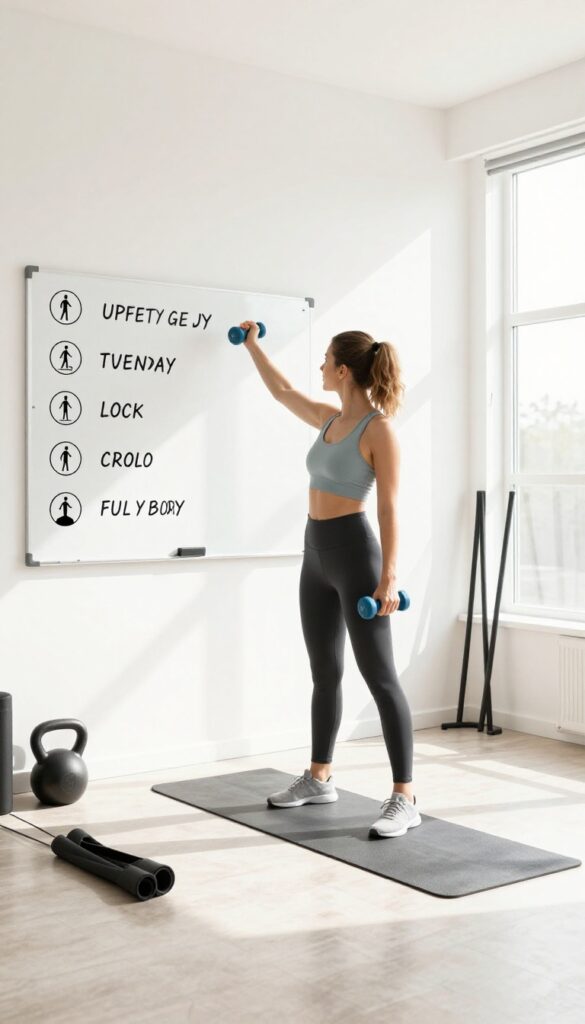
A consistent schedule helps you stay on track without overthinking. Here’s how to arrange your four workout days and rest days for maximum results and recovery.
This plan follows a straightforward weekly rhythm: two strength days, one active recovery or cardio day, and one full-body or HIIT day. The key is to alternate upper and lower body work, then finish the week with a total-body challenge. You’ll have three rest days built in, so your muscles can repair and grow.
Weekly Schedule Overview
- Day 1: Upper Body Strength – Focus on pushing and pulling movements for chest, back, shoulders, and arms.
- Day 2: Lower Body Strength – Target glutes, quads, hamstrings, and calves with compound exercises.
- Day 3: Active Recovery or Cardio – Choose light activity like walking, yoga, or steady-state cardio.
- Day 4: Full Body or HIIT – Combine strength and cardio for a time-efficient, calorie-torching session.
- Rest days: Place them between strength days and after HIIT to optimize recovery.
How to Arrange Your Days
You can schedule your workouts on Monday, Tuesday, Thursday, and Saturday, for example, with rest on Wednesday, Friday, and Sunday. Or adjust to fit your life – just keep at least one rest day between strength sessions and avoid doing HIIT on consecutive days. The goal is consistency, not perfection.
Day 1: Upper Body Strength

Day 1 kicks off your week with an upper body strength session. This workout targets your chest, back, shoulders, arms, and core, building functional strength and improving posture. You'll need a pair of dumbbells and a mat.
Let's get started.
Warm-Up (5-10 minutes
Prepare your upper body with dynamic movements to increase blood flow and reduce injury risk.
- Arm circles: 30 seconds forward, 30 seconds backward
- Shoulder rolls: 10 each direction
- Cat-cow stretch: 10 slow breaths
- Push-up prep: 10 incline push-ups (hands on a bench or wall)
- Band pull-aparts (optional): 15 reps
Main Workout (30-40 minutes
Perform 3 sets of 10-12 reps for each exercise. Rest 60 seconds between sets. Focus on controlled movements and proper form.
- Push-ups (knee or full): Keep core tight, lower chest to floor, elbows at 45 degrees.
- Dumbbell rows: Hinge at hips, back flat, pull dumbbell to hip, squeeze shoulder blade.
- Dumbbell shoulder press: Press overhead, avoid arching lower back, control the descent.
- Bicep curls: Keep elbows pinned to sides, curl dumbbells up, lower slowly.
- Tricep dips (on bench or chair): Lower body until elbows are 90 degrees, push back up.
Cool-Down (5 minutes
Stretch your worked muscles to improve flexibility and aid recovery.
- Chest stretch: Hold a doorway or wall, gently lean forward, 30 seconds each side.
- Tricep stretch: Reach one arm overhead, bend elbow, gently pull elbow with opposite hand, 30 seconds each side.
- Shoulder stretch: Bring one arm across chest, hold with opposite hand, 30 seconds each side.
- Child's pose: Kneel, sit back on heels, extend arms forward, breathe deeply for 1 minute.
Day 2: Lower Body Strength
Day 2 focuses on building lower body strength with compound and isolation exercises. These moves target your glutes, quads, hamstrings, and calves, helping you build a strong foundation and improve overall stability.
Warm-Up
Start with 5–10 minutes of light cardio like brisk walking or jumping jacks, then perform dynamic stretches: leg swings, hip circles, and bodyweight squats. This prepares your muscles and joints for the work ahead.
Main Workout
- Goblet Squats – Hold a dumbbell at your chest, keep your chest up, and squat down until your thighs are parallel to the floor.
- Walking Lunges – Step forward into a lunge, ensuring your front knee stays aligned with your ankle. Alternate legs.
- Romanian Deadlifts – With a slight bend in your knees, hinge at your hips and lower the dumbbells along your shins, keeping your back flat.
- Glute Bridges – Lie on your back, knees bent, feet flat. Drive your hips up, squeezing your glutes at the top.
- Standing Calf Raises – Hold a dumbbell in one hand, rise onto your toes, and lower slowly.
Cool-Down
Finish with 5–10 minutes of static stretching. Hold each stretch for 20–30 seconds: quad stretch, hamstring stretch, glute stretch, and calf stretch. This helps reduce muscle soreness and improves flexibility.
Form Cues
Keep your core engaged throughout each movement. For squats and lunges, ensure your knees don't cave inward. For deadlifts, maintain a neutral spine and hinge from your hips, not your lower back.
Day 3: Active Recovery or Cardio
Day 3 is all about giving your muscles a break while still keeping your body moving. Active recovery helps reduce soreness, improve circulation, and prepare you for the next strength session. You don’t need to push hard—just move at an easy pace.
Why Active Recovery Matters
After two days of strength training, your muscles need time to repair. Active recovery—low-intensity movement—flushes out metabolic waste, delivers nutrients to tissues, and keeps your joints mobile without adding stress. It also helps maintain consistency in your routine without risking burnout or injury.
Options for Active Recovery
- Brisk walk: 30-45 minutes outdoors or on a treadmill.
- Light jog: Keep it easy, not breathless.
- Cycling: Flat terrain, moderate pace.
- Yoga: Focus on gentle flows or restorative poses.
- Stretching: Full-body flexibility routine.
Duration and Intensity
Aim for 30-45 minutes. Your effort level should be about 3-4 out of 10. If you feel tired or sore, take it even easier or opt for a rest day instead.
What to Avoid
Do not do high-intensity interval training (HIIT) or heavy strength work on this day. The goal is recovery, not fatigue.
Day 4: Full Body or HIIT
Day 4 is your wildcard—choose the option that matches your energy and goals. If you're feeling strong, go for full body strength. If you want a quick, intense sweat, HIIT is your pick.
Option A: Full Body Strength
Focus on compound lifts that work multiple muscle groups at once. This keeps your workout efficient and effective.
- Deadlifts: 3 sets of 8–10 reps
- Push-ups: 3 sets of as many reps as possible
- Squats: 3 sets of 10–12 reps
- Bent-over rows: 3 sets of 8–10 reps per side
- Plank: 3 sets holding for 30–60 seconds
Option B: HIIT Cardio
High-Intensity Interval Training torches calories and boosts cardiovascular fitness in less time. The classic 20/10 Tabata format works great.
- 20 seconds of all-out effort (e.g., sprints, burpees, jump squats)
- 10 seconds of rest
- Repeat for 8 rounds (4 minutes per exercise)
- Choose 3–4 exercises, rest 1 minute between exercises
How to decide: If your week has been heavy on strength, pick HIIT. If you've had more cardio, go full body. Listen to your body—both options are effective, so choose what feels right today.
Warm-Up and Cool-Down Essentials
Warming up and cooling down are not optional extras—they are essential parts of your workout. A proper warm-up prepares your body for exercise, reducing injury risk and improving performance. Cooling down helps your body transition back to rest, aiding recovery and reducing muscle soreness.
Why Warm-Up and Cool-Down Matter
Skipping your warm-up can lead to pulled muscles, joint strain, and decreased workout quality. A cool-down prevents blood pooling, helps flush out metabolic waste, and promotes flexibility. Each takes just 5–10 minutes but pays off in long-term progress.
Always start with a dynamic warm-up to increase blood flow and mobility. After your workout, switch to static stretching to lengthen muscles and improve range of motion.
Sample Warm-Up Routine (5–10 Minutes
Perform each move for 30–60 seconds, moving through a full range of motion without bouncing.
- Arm circles (forward and backward)
- Leg swings (front to back, side to side)
- Torso twists
- Hip circles
- Bodyweight squats
- Cat-cow stretches
- High knees or marching in place
Sample Cool-Down Routine (5–10 Minutes
Hold each stretch for 20–30 seconds, breathing deeply. Never push into pain.
- Quad stretch (standing or lying)
- Hamstring stretch (seated or standing)
- Chest stretch (doorway or standing)
- Triceps stretch (overhead)
- Child’s pose
- Seated forward fold
- Glute stretch (pigeon pose or figure-four)
Pro Tip
If you’re short on time, even 5 minutes of dynamic movement before and 5 minutes of stretching after is far better than nothing. Make it a non-negotiable part of your routine.
Nutrition Tips to Support Your Workouts
What you eat around your workouts can make a big difference in how you feel and perform. You don’t need a complicated meal plan—just a few smart habits to fuel your body and help it recover.
Focus on timing and balance rather than strict rules. Eating the right nutrients at the right times will give you energy for your sessions and help your muscles repair afterward.
Key Nutrition Tips
- Eat protein within two hours after your workout to support muscle repair and growth. Good options include Greek yogurt, a protein shake, chicken, eggs, or tofu.
- Stay hydrated throughout the day. Water is usually enough, but if you sweat heavily, consider an electrolyte drink after intense sessions.
- Balance carbs and fats. Carbs provide quick energy for your workouts, while healthy fats support hormone function and overall health. Don’t cut either out entirely.
Pre-Workout Snack Ideas
A small snack 30–60 minutes before exercise can top off your energy stores. Choose something easy to digest, like a banana, a slice of whole-grain toast with peanut butter, or a small smoothie.
Post-Workout Meal Ideas
Within two hours of finishing, aim for a meal that combines protein and carbs. For example, grilled chicken with sweet potatoes and vegetables, a quinoa bowl with beans and avocado, or a turkey sandwich on whole-grain bread.
Remember, consistency matters more than perfection. Listen to your body and adjust portions based on your hunger and energy levels. These simple habits will support your workouts without adding stress.
How to Progress and Stay Motivated
Seeing results and staying consistent go hand in hand. Without a clear way to track improvement, motivation can fade. Here’s how to keep moving forward without overcomplicating things.
Progression doesn’t have to mean lifting heavier every week. The simplest methods are often the most sustainable.
Simple Progression Methods
- Increase weight by 2.5–5 lb when you can complete all reps with good form.
- Add one more rep to each set before increasing weight.
- Reduce rest time between sets by 15–30 seconds.
- Add an extra set to an exercise you’ve been doing for 3+ weeks.
Track your workouts in a notebook or app. Write down the exercises, weights, reps, and how you felt. This small habit shows you exactly where you’re improving and helps you plan your next step.
Staying Motivated Long-Term
- Mix up exercises every 4–6 weeks to keep things fresh. Swap dumbbell rows for band rows or goblet squats for lunges.
- Set small, non-scale goals like doing one more push-up or holding a plank 10 seconds longer.
- Schedule your workouts like appointments. Put them in your calendar and treat them as non-negotiable.
- Find a workout buddy or join an online community for accountability.
Remember
Progress isn’t always linear. Some weeks you’ll feel stronger, others you’ll need more rest. That’s normal.
Focus on showing up consistently, and the results will follow.
FAQ
Can I do this plan at home?
Absolutely. All exercises can be done with minimal equipment like dumbbells, resistance bands, or just bodyweight. The plan is designed to be gym-optional.
What if I miss a day?
Don't stress. Just pick up where you left off. If you miss a strength day, skip the recovery day and do the strength day instead.
Consistency over perfection.
How long until I see results?
With consistent effort and proper nutrition, you may notice changes in 4-6 weeks. Strength gains often come first, followed by visible changes in muscle tone.
Do I need equipment?
Some basic equipment like dumbbells or resistance bands is helpful for strength days, but you can modify many exercises to be bodyweight-only. Start with what you have.
Conclusion
This 4-day workout plan gives you a clear, manageable structure that fits into your life. By focusing on strength, recovery, and consistency, you'll build a routine that works for the long term. Remember, the best workout is the one you actually do.
Start with week one, listen to your body, and adjust as needed. Progress takes time, but every workout brings you closer to your goals. You've got this—now go make it happen.

Dr. Pallab Kishore, MS in Orthodontics and owner of Orthodontic Braces Care, shares expert tips on braces, aligners, and oral health from 10+ years of experience.